
No products in the cart.

Short answer: Reselling is legal in India. It is also profitable for people who buy right, count every cost and test small. It is not profitable for people who copy a price, ignore shipping and returns, or buy a large stock of something nobody asked for. The rest of this guide shows you how to tell the difference with real numbers.
Reselling means buying products from a supplier and selling them to customers at a higher price. You do not make the product. You find it, price it, sell it and deliver it. People resell on marketplaces, on Instagram and WhatsApp, in local shops and through their own websites. Because you can start with a small amount, reselling is the most common first business for students, homemakers, job holders who want extra income, and small shop owners who want to go online.
Two questions come up again and again in search: is reselling business legal in India, and is it really profitable? This guide answers both with the actual rules and actual numbers, and it points out the scams to avoid. This is general information, not legal or tax advice.
Is reselling business legal in India?
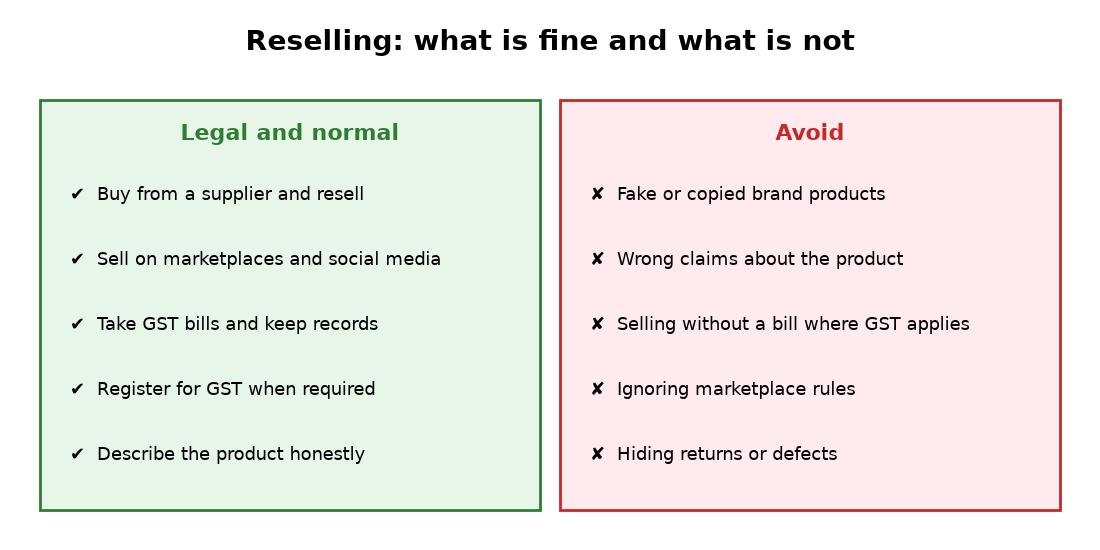
Yes. Buying a genuine product and selling it on is a normal, legal trade. Every shop in your city is a reseller. What makes reselling legal or illegal is not the idea, it is how you do it. Here is what you need to get right.
1. Sell genuine products
Never sell fake or copied branded goods. Using someone else’s brand name or logo without permission can lead to legal action and account bans on marketplaces. Sell unbranded or generic products, or products you are authorised to sell, and describe them honestly.
2. Take proper bills and keep records
Buy from suppliers who give a bill, and keep every purchase and sale record. Bills protect you if a customer, a marketplace or a tax officer asks questions. At WholesaleOye, GST bills are available and prices are shown plus GST.
3. Understand GST
Whether you need a GST number depends on what you sell, your turnover and where your customers live. Small sellers of goods may be able to sell on some marketplaces without a GST number if they stay within one state and under the turnover limit, but selling across states needs registration. We explain the rule in detail in sell on Meesho without GST.
4. Follow product labelling and platform rules
Products sold to consumers usually need honest listing details such as price, quantity and country of origin where required. Marketplaces also have their own rules for photos, titles and returns. Read the seller policy of each platform before you list.
5. Be careful with “reselling” schemes that ask you to pay to join
A real reselling business sells a product to customers. If a “reselling app” or group asks you to pay a joining fee and earns mainly by getting you to recruit others, treat it as a red flag. Check reviews, ask for a bill for every payment, and never pay large amounts to unknown people on social media.
Is reselling profitable? The honest maths
Reselling can be profitable, but the selling price is not your profit. Between the price a customer pays and what lands in your bank there are several costs, and beginners usually forget most of them. Here is a worked example using real numbers from our store. A Bathroom Floor Cleaning Wiper with a rotating head costs Rs 101 plus GST at WholesaleOye. Marketplace listings of similar products show a price around Rs 279. Here is what that looks like after costs. The shipping, fee and returns figures are assumptions for illustration. Your numbers will differ.
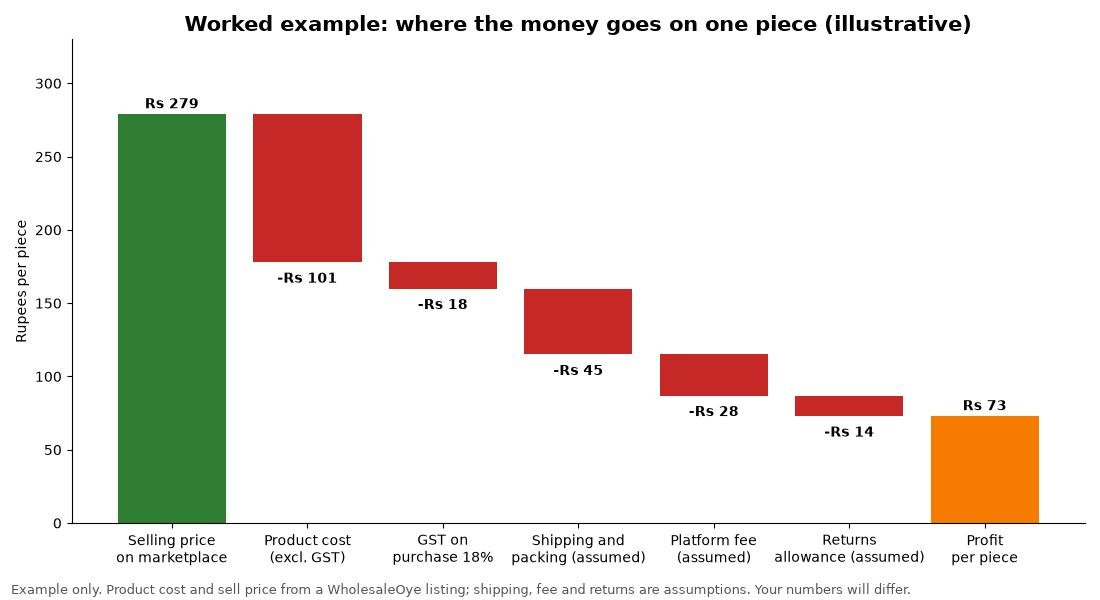
| Item | Rs per piece |
|---|---|
| Selling price on marketplace | 279 |
| Product cost (excluding GST) | 101 |
| GST on purchase at 18% | 18 |
| Shipping and packing (assumed) | 45 |
| Platform fee (assumed) | 28 |
| Returns allowance (assumed) | 14 |
| Profit per piece | 73 |
If you sell 100 pieces a month at this profit, that is about Rs 7,300. If you sell 10 pieces, it is Rs 730. This is why your volume and your repeat orders matter as much as your margin. If you want to see how margins differ by category, our data in the wholesale products list with high margin shows estimated earnings per piece across eight categories.
Where beginners lose money
- Buying too much, too soon. A large first order of one product is the quickest way to get stuck with stock. Order one sample piece first.
- Copying a competitor’s price. Their cost may be lower than yours. Always work out your own numbers.
- Forgetting returns. Returns cost you the product, shipping both ways and sometimes a fee. Add an allowance to every price.
- Spending on ads before the listing is ready. Weak photos and titles waste ad money.
- Choosing products with no repeat demand. One-time products need new customers every time. Everyday-use products bring repeat buyers.
- Ignoring GST and bills. It becomes a problem when your turnover grows.
What a good reselling product looks like
- People already search for it and buy it.
- The gap between your cost and the marketplace price is large enough to cover shipping, fees and returns and still leave profit.
- It is small and light, so shipping is cheap.
- It does not break easily and does not come in sizes.
- It solves a clear problem, such as cleaning, storage or small repairs.
Our product pages show a Trend Meter with the demand and an estimate of what the product sells for on marketplaces, so you can check the gap before you buy.
Ways to resell
| Channel | Good for | Watch out for |
|---|---|---|
| Marketplaces (Amazon, Flipkart, Meesho) | Ready customers, no website needed | Fees, competition, platform rules |
| Instagram and WhatsApp | No platform fee, direct relationship | You must find your own customers |
| Local shop or stall | Quick cash sales | Limited reach, rent |
| Your own online store | Brand and repeat customers | Needs traffic and set up time |
Moumita explains how reselling works for beginners in this video.
How many pieces do you need to sell to earn a target income?
Profit per piece sets the volume you need. Using the Rs 73 profit from the example above, here is how many pieces a month different targets need. The numbers are simple division, so use your own profit per piece.
| Monthly profit target | Pieces needed at Rs 73 profit | About per day |
|---|---|---|
| Rs 5,000 | 69 | 2 to 3 |
| Rs 10,000 | 137 | 4 to 5 |
| Rs 20,000 | 274 | 9 |
| Rs 50,000 | 685 | 23 |
This table also shows why one product is rarely enough. Most resellers build a small range of five to ten products that sell steadily, so their daily orders come from several items.
Cheap product or higher-priced product: which gives better profit?
It is easy to assume a higher-priced product makes more money. Our Trend Meter data shows it is not that simple. A window screen cleaning brush that costs Rs 54 plus GST at WholesaleOye shows a marketplace price near Rs 274 and an estimated earning near Rs 210 per piece before your own costs. A floor wiper that costs Rs 101 shows a marketplace price near Rs 279 and an estimated earning near Rs 160. The cheaper item leaves more room, but it also depends on demand, competition and how many sellers already list it. Check all three before you decide: your cost, the marketplace price and the demand. A low cost with no demand is a trap, and so is a high demand with a price war.
Income tax on reselling income
Profit from reselling is business income, and business income is generally taxable under income tax rules, whether you earn it part-time or full-time. This is separate from GST. Keep your sales records, purchase bills and expense receipts, because they decide your taxable profit. The details depend on your total income and the scheme you choose, so speak to a chartered accountant once your sales become regular. This is general information and not tax advice.
Products and habits that make reselling risky
- Branded lookalikes. They can lead to listing removals and legal notice.
- Regulated products. Items such as medicines, food supplements and some electronics have extra rules. Stay with general merchandise while you learn.
- Fragile or sized products. Glass, clothing and shoes bring more breakage and size returns.
- Single supplier dependence. If one supplier runs out, your listing dies. Keep a second source for your best sellers.
- Mixing money. Keep a separate account for the business so you can see the real profit.
How much time does reselling take?
For a part-time reseller, the main work is photographing and listing products, answering customer questions, packing and handing parcels to the courier, and checking stock. Many people spend one to three hours a day at the beginning. Time goes down as you learn which products sell and as you build a simple routine. If you use dropshipping, packing time goes down, but you spend more time following up with the supplier.
Reselling vs dropshipping
In reselling you buy the stock and ship it yourself. In dropshipping the supplier ships to your customer, so you hold no stock but you depend on the supplier for packing and speed. Dropshipping needs less money at the start, but your margin is thinner and you have less control. WholesaleOye supports dropship orders, and cash on delivery is available for dropship orders only. Wholesale B2B orders are not cash on delivery.
A simple plan to start
- Week 1: Choose one category and check demand and prices on marketplaces.
- Week 2: Order one sample piece of two or three products. Shipping is free for the 1 pc sample at WholesaleOye. Check the quality.
- Week 3: Photograph the product well, list it, and share it with people you know.
- Week 4: Count your real profit. If it works, reorder a small quantity. If not, change the product.
Read how to start a reselling business in India with a small budget and how to buy wholesale products in small quantity for details.
Reselling business meaning in Hindi (short)
Reselling business ka matlab hai kisi supplier se product kharidna aur apne customers ko zyada price par bechna. Aapko product banana nahi padta. Bas sahi product chunna hai, sahi price lagana hai aur customer tak pahunchana hai.
Frequently asked questions
Is reselling business legal in India?
Yes. Reselling genuine products is legal. Avoid fake branded goods, keep bills and records, and follow GST and platform rules.
Is reselling business profitable?
It can be, but only after you count the cost, GST, shipping, platform fees and returns. See the worked example above. Start small and test.
How much money do I need to start reselling?
You can start with a small amount by ordering a single sample piece and growing as orders come in. Many sellers start with a few thousand rupees of stock.
Do I need a GST number for reselling?
It depends on your turnover, what you sell and where you sell. Small sellers who stay in one state may have lighter rules. Selling across states needs GST registration. Check the current rules or ask an accountant.
Can I do reselling from home?
Yes. Many resellers work from home using their phone, social media and a marketplace account.
Is reselling a good business for beginners?
Yes, because the risk is low when you buy in small quantity. The main skill is choosing the right product and tracking your costs.
What is the difference between reselling and dropshipping?
In reselling you buy and ship the stock yourself. In dropshipping the supplier ships the order for you.
How do I avoid reselling scams?
Do not pay joining fees to unknown people, ask for a bill for every payment, and prefer suppliers with clear policies on returns, delivery and GST bills.
Keep reading
Last updated: 12 November 2026. Cost figures other than the product price and marketplace price are assumptions for illustration.

Written by Moumita Biswas
Co-Founder, WholesaleOye
Moumita Biswas is a Co-Founder of WholesaleOye and Co-Founder and COO of ZaaYega, based in Bengaluru. An eCommerce entrepreneur since 2012, she helps small retailers, wholesalers and SMEs sell products online across marketplaces. She also teaches sellers through Zaayega Academy and the Zaayega Seller Gyan YouTube channel.


5 Comments