
No products in the cart.

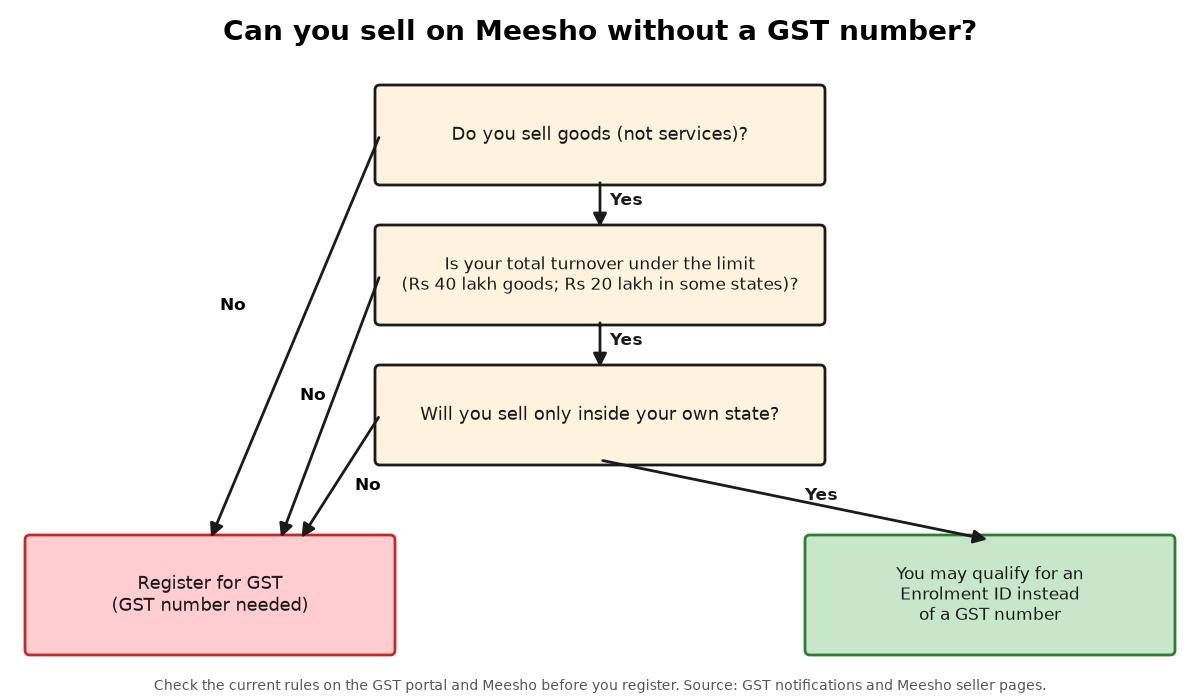
Short answer: Yes, in some cases. A small seller of goods can sell on Meesho without a GST number if total turnover stays under the GST limit and every sale stays inside one state. In that case Meesho can onboard you with a GST Enrolment ID instead. The moment you want to sell to customers in other states, or your turnover crosses the limit, you need a GST number. Always check the current rules before you register.
“Can I sell on Meesho without GST?” is one of the most searched questions by new online sellers in India, and it is easy to see why. GST registration sounds like paperwork, a cost and a risk, when all you want to do is test a few products. The honest answer is neither “yes, never need it” nor “no, always needed”. It depends on three things: what you sell, how much you sell, and where your customers live.
This guide explains how to sell on Meesho without GST: who qualifies, what the limits are and when you will need to register.
This guide is part of our complete series on how to sell on Amazon, Flipkart and Meesho.
This guide explains the rule in plain words, shows you the exact conditions, walks through what an Enrolment ID is, and then does the maths on what selling without GST really means for your profit. We also list the mistakes we see new sellers make and a step-by-step checklist you can follow today.
This article is for general information and is not tax advice. GST rules and marketplace policies change. Confirm the current position on the GST portal and on Meesho’s seller pages, or ask a chartered accountant, before you act.
Why GST matters when you sell on a marketplace
GST (Goods and Services Tax) is the tax charged on the sale of goods and services in India. Normally, a business that sells goods only needs to register for GST once its yearly turnover crosses a limit. The usual limit for sellers of goods is Rs 40 lakh a year (Rs 20 lakh in some special category states). Below that limit, a small shop selling in its own town does not have to register.
Selling on a marketplace used to change this. For years, anyone selling through an e-commerce operator such as Amazon, Flipkart or Meesho had to register for GST from the very first sale, even if their turnover was tiny. This was one of the biggest barriers for small sellers, home businesses and first-time entrepreneurs.
What changed: relief for small online sellers
The GST Council decided to waive mandatory registration for small sellers who supply goods through e-commerce operators, provided they meet two main conditions: their total turnover is below the registration limit, and they do not make any inter-state supply. This was reported when the decision was announced, for example by Inc42, which also linked it to the government’s push to bring small sellers onto ONDC. Business media such as Outlook Business covered the discussion around allowing small suppliers to sell across states without registration, but the rule that was put in place keeps the inter-state restriction.
The relief took effect from 1 October 2023 through a government notification (reported as Notification 34/2023 – Central Tax). A second notification set a special procedure for the marketplaces that list these unregistered sellers: they must track the seller’s enrolment status and location. In practice this means that the marketplace, not just you, is checking that you stay within the rules.
The Enrolment ID: what it is
If you are not registered for GST, the platform still needs a way to identify you for the tax system. That is the Enrolment ID. It is a number you get from the GST portal after you enrol as an unregistered supplier selling goods through an e-commerce operator. To enrol you need a valid PAN. After your PAN is validated, the portal issues the Enrolment ID, which you then enter in your Meesho seller account in place of a GST number.
Meesho’s own seller pages describe the non-GST route, and seller guides report that the basic requirements are a PAN, an active bank account and the Enrolment ID. Details of the screens change, so follow what Meesho shows when you sign up rather than an old screenshot.
The four conditions you must meet
- You sell goods. The relief is for suppliers of goods. Services follow different rules.
- Your total turnover stays under the limit. This is your all-India turnover, not only your Meesho sales. If you also sell on other marketplaces or offline, add it all up. The commonly reported limits are Rs 40 lakh for goods and Rs 20 lakh in special category states.
- You sell inside one state only. You cannot make inter-state sales. Meesho shows non-GST sellers’ products only to customers in the seller’s own state, so your market is that one state.
- You hold a PAN and a valid Enrolment ID. Without them, the platform cannot onboard you on the non-GST route.
What you cannot do without a GST number
- Sell to other states. This is the biggest limit. If your state has a small market for your product, your sales will be small.
- Charge GST separately. Unregistered sellers cannot collect GST from the customer. You sell at one price with no tax shown.
- Claim input tax credit. If you buy stock and pay 18% GST to your supplier, you cannot claim that GST back, because you are not registered. It becomes part of your cost.
- Keep selling after you cross the limit. Once your turnover goes over the threshold, you must register.
Selling without GST vs with GST: side by side
| Without GST (Enrolment ID) | With GST number | |
|---|---|---|
| Where you can sell | Only inside your own state | All over India |
| Turnover limit | Must stay under the GST limit | No such limit |
| Charge GST to customer | No | Yes, where applicable |
| Claim GST paid on purchases | No | Yes, subject to rules |
| Returns and compliance | Lighter | Regular GST filing needed |
| Best for | Testing, local selling, very small sellers | Growing sellers and anyone who wants national reach |
The real cost: what it does to your profit
Most articles stop at the rule. The number that matters for your business is the margin. Take a real product from our store: a Silicone Sink Splash Guard (48 cm) costs Rs 89 plus GST at WholesaleOye. With 18% GST the full price is about Rs 105. Our Trend Meter shows this type of product selling for around Rs 209 on marketplaces.
- If you are not registered, you cannot claim the Rs 16 GST back. Your cost is Rs 105 per piece, before shipping, packing and returns.
- If you are registered, you can usually claim input credit on the GST you paid when you file, which lowers your real cost, but you must also collect and pay GST on your sale and file returns.
Neither route is automatically better. For a beginner testing a product in one state, the lighter non-GST route can be the safer start. For a seller who wants to sell across India, GST registration is the normal path and also adds trust with buyers and suppliers.
How to start selling on Meesho without GST: step by step
- Check you qualify. Goods, turnover under the limit, one state.
- Keep your PAN and bank account details ready.
- Enrol on the GST portal as an unregistered supplier for e-commerce sales and note the Enrolment ID once it is issued.
- Create your Meesho supplier account and choose the option for sellers without a GST number. Enter the Enrolment ID when asked.
- Pick a product people in your state want. Order one sample piece first, check quality and photos, and then list it.
- Keep records. Save every purchase bill and sales record. You will need them if you register later.
- Watch your turnover. Add up all sales across all channels. Plan to register before you reach the limit.
Video: Selling on Meesho with and without GST
Moumita explains the real difference between selling on Meesho with and without GST in this video from the ZaaYega Seller Gyan channel.
Which products suit a one-state, no-GST start?
When you can only sell inside one state, the product choice matters more than anything else. Choose items with steady everyday demand that are easy to ship and rarely returned: kitchen helpers, cleaning brushes, organisers, small accessories and personal care basics. Avoid fragile or size-dependent items until you understand your return rate. For ideas, see our guide to the best wholesale products to sell online and the wholesale products list with high margin.
If you source from a wholesale supplier, ask for a proper GST bill. At WholesaleOye, prices are shown plus GST and GST bills are available. You can start by ordering a single piece as a sample. Shipping is free for the 1 pc sample, while other orders pay by weight slab. We have an easy 5-day return policy, and we deliver to 25000+ pincodes. See how to buy wholesale products in small quantity for the full process.
Seven mistakes new sellers make
- Selling to other states by accident. Check how your platform and courier settings handle delivery locations.
- Forgetting total turnover. The limit counts all channels together.
- Using someone else’s GST number. Never do this. It can create tax problems for both of you.
- Not saving bills. Without bills you cannot prove your costs or move to GST smoothly later.
- Underpricing because there is no GST. Your costs still include the GST you paid on stock.
- Ignoring returns. Returns reduce profit. Add a small allowance to every price.
- Believing old advice. Many blog posts and videos still show the old rule that GST was needed from the first sale. Check the date of any advice you read.
When to move to GST registration
Plan to register when you want to sell to customers in other states, when your turnover is getting close to the limit, when you want to claim GST credit on your purchases, or when you want to sell on several marketplaces. Registration on the GST portal does not carry a government fee. After you register, you will need to file regular returns, so many small sellers use an accountant or a billing tool. Our GST, shipping and returns guide covers the basics.
What about Amazon and Flipkart?
The GST law is the same for every marketplace, because the relief applies to e-commerce operators in general. However, each platform has its own seller onboarding screens, policies and approval steps, and they can differ from Meesho’s. Some may still ask for a GST number for certain categories or accounts. Always read the current seller registration page of the platform you want to use. We cover the other platforms in our marketplace seller guide.
Frequently asked questions
Can I sell on Meesho without a GST number?
Yes, if you sell goods, your total turnover is under the GST limit, and you sell only within your own state. You use an Enrolment ID from the GST portal instead of a GST number.
Can I open a Meesho seller account without GST?
Meesho offers a route for sellers without a GSTIN that uses a PAN, a bank account and an Enrolment ID. Follow the steps shown in the Meesho seller sign-up, as the screens change over time.
What is an Enrolment ID?
It is a number issued through the GST portal to an eligible unregistered seller of goods on an e-commerce marketplace, after the seller’s PAN is validated.
Can I sell to other states without GST?
No. Selling to another state is an inter-state supply, and under the current rule you need GST registration for that.
Do I need GST if my sales are below Rs 40 lakh?
Not necessarily, but only if you also stay within one state and use the Enrolment ID route. If you sell across states you need GST even with low sales.
Is selling on Meesho profitable?
It can be, but profit depends on product cost, shipping, returns and platform charges. Work out your margin per piece before you list. See our worked example in is reselling business legal and profitable in India.
Can I sell on Amazon or Flipkart without GST?
The same law applies, but each platform sets its own onboarding rules. Check the platform’s current seller registration page.
Do I need GST if I only buy wholesale for my own shop?
That depends on your turnover and what you sell. Ask your accountant. You can still ask your supplier for a GST bill for your records.
What happens if I cross the turnover limit?
You must register for GST and start collecting and filing GST. Keep clean records from day one so the change is easy.
Sources
- Inc42: GST Council waives registration requirement for small online sellers
- Outlook Business: small suppliers and inter-state sales on e-commerce platforms
- Meesho: platform made non-GST inclusive for new sellers
- GST portal (official)
Last updated: 12 November 2026.
GST for Meesho seller: what applies and when
Many new sellers ask about GST for Meesho seller accounts. Meesho’s rules have allowed some sellers to start without a GST number under specific conditions, but the rules, limits and your own tax duties can change. Confirm current terms on Meesho’s seller pages and with your accountant, and read GST registration for online sellers to plan for the day you cross the limit.
Related guides

Written by Moumita Biswas
Co-Founder, WholesaleOye
Moumita Biswas is a Co-Founder of WholesaleOye and Co-Founder and COO of ZaaYega, based in Bengaluru. An eCommerce entrepreneur since 2012, she helps small retailers, wholesalers and SMEs sell products online across marketplaces. She also teaches sellers through Zaayega Academy and the Zaayega Seller Gyan YouTube channel.


2 Comments